Executive MBA in Germany
Table of Contents
- Key Benefits of Executive MBA in Germany
- Executive MBA vs MBA vs Part-Time MBA
- Best Executive MBA in Germany
- 1 Year Executive MBA in Germany
- Course Modules of Executive MBA in Germany
- Executive MBA in Germany Cost
- Scholarships for Executive MBA in Germany
- Eligibility Requirements
- Application Process
- Career Opportunities After an Executive MBA
- ROI Analysis of Executive MBA in Germany
- Author's Final Thought
Executive MBA programmes in Germany are designed for experienced professionals who want to advance into senior leadership or C-suite positions without taking a career break. Executive MBA in Germany allows participants to continue working while attending classes through weekend modules, block teaching schedules, blended learning and international residencies. Most programmes are delivered entirely in English and emphasise leadership, global strategy, innovation and executive decision-making.
For Indian professionals with managerial experience, pursuing Executive MBA in Germany offers access to globally recognised business schools, extensive corporate networking opportunities, and exposure to Europe's largest economy. Tuition fees range from €40,000–€260,000 (Approx. ₹40 lakh–₹2.6 crore) depending on the institution and programme format. Most universities require 3–5 years of professional work experience, although highly ranked schools often prefer candidates with 8–12 years of managerial experience.
Key Highlights
Particular | Details |
Programme Duration | 15–24 months |
Study Mode | Part-time, Weekend, Modular, Hybrid |
Language of Instruction | English |
Work Experience Required | Usually 3–5 years (senior programmes often prefer 8+ years) |
Tuition Fees | €40,000–€260,000 (Approx. ₹40 lakh–₹2.6 crore) |
Average Class Profile | Mid to senior-level professionals |
Scholarships Available | Merit, leadership, diversity, corporate sponsorships |
Average Post-MBA Salary | €90,000–€180,000 annually (Approx. ₹90 lakh–₹1.8 crore) |
Key Benefits of Executive MBA in Germany
Professionals often pursue an Executive MBA to accelerate career progression, transition into leadership positions, or expand their global business network. Germany combines internationally respected business education with close collaboration between universities and multinational organisations, making it an attractive destination for experienced managers.
The table below highlights the key advantages.
Benefit | Why It Matters |
Continue working while studying | Earn a degree without sacrificing career progression or income. |
Leadership development | Focuses on executive decision-making, organisational leadership, and strategic management. |
International exposure | Includes global study modules, international residencies, and multicultural classrooms. |
Strong corporate network | Build connections with senior executives, entrepreneurs, and global employers. |
Career acceleration | Supports promotions into director, vice president, and C-suite positions. |
Practical learning | Classroom concepts are immediately applied within your workplace. |
Globally recognised qualification | Degrees are respected by employers across Europe, Asia, and North America. |
Technology and innovation ecosystem | Germany's strong industrial and technological landscape benefits professionals in engineering, manufacturing, consulting, and digital industries. |
Executive MBA vs MBA vs Part-Time MBA
Many applicants are unsure whether they should pursue a traditional MBA, a part-time MBA, or an Executive MBA. Although all three qualifications develop business and leadership skills, they cater to professionals at different career stages.
Which Programme Should You Choose?
The comparison below explains the distinctions.
Feature | MBA | Executive MBA | Part-Time MBA |
Ideal Candidate | Early-career professionals | Mid to senior-level professionals | Working professionals |
Work Experience | 2–3 years | 3–10+ years | 2–5 years |
Study Mode | Full-time | Weekend/Modular | Evening/Weekend |
Continue Full-Time Job | Usually No | Yes | Yes |
Leadership Focus | Moderate | Extensive | Moderate |
Peer Experience | Mixed | Experienced managers and executives | Working professionals |
Networking Opportunities | Strong | Exceptional executive-level network | Strong |
For professionals with substantial managerial responsibilities, an Executive MBA in Germany generally provides greater value because classroom discussions are built around real-world executive experience.
Best Executive MBA in Germany
Germany is home to several internationally recognised business schools offering Executive MBA programmes that consistently rank among Europe's best. These programmes combine academic excellence with practical leadership development and extensive corporate partnerships.
Top Universities Offering Executive MBA in Germany
Each institution offers a different learning model, tuition structure, and specialisation. Comparing programmes helps applicants identify the best fit for their professional goals.
The table below highlights some of the best Executive MBA in Germany options.
University | Duration | Approximate Tuition Fees |
ESMT Berlin | 18 months | €50,000–60,000 (Approx. ₹50–60 lakh) |
Mannheim Business School | 18 months | €45,000–50,000 (Approx. ₹45–50 lakh) |
Frankfurt School of Finance & Management | 18–24 months | €42,000–48,000 (Approx. ₹42–48 lakh) |
TUM Institute for Lifelong Learning | Around 18 months | €39,000–45,000 (Approx. ₹39–45 lakh) |
IESE Business School (Munich Campus) | 18–20 months | €90,000–100,000 (Approx. ₹90 lakh–₹1 crore) |
WHU – Otto Beisheim School of Management | 18 months | €45,000–55,000 (Approx. ₹45–55 lakh) |
Note: Tuition fees are indicative and may vary by intake, scholarships, exchange modules, and programme revisions.
1 Year Executive MBA in Germany
Many professionals search for 1 year Executive MBA in Germany, but such programmes are relatively uncommon. Most Executive MBAs are intentionally spread across 15–24 months to accommodate full-time employment and provide sufficient practical exposure.
Universities Offering Short-Duration Executive MBAs
The table below provides examples.
University | Duration | Format |
ESMT Berlin | 18 months | Modular |
Mannheim Business School | 18 months | Part-time |
Frankfurt School | 18–24 months | Weekend |
TUM | Around 18 months | Modular |
Note: If your priority is completing the degree quickly, discuss programme flexibility directly with the university before applying.
Course Modules of Executive MBA in Germany
Executive MBA focuses on advanced management and leadership rather than introductory business concepts. The curriculum combines strategic thinking, finance, innovation, and organizational leadership while allowing professionals to apply classroom learning directly in their workplace.
Although modules vary across universities, most Executive MBA courses in Germany include the following core subjects.
The table below outlines the typical curriculum.
Course Module | Focus Area |
Strategic Management | Long-term business planning and competitive advantage |
Financial Management | Corporate finance and investment decisions |
Business Analytics | Data-driven decision making |
Leadership & Organizational Behavior | Executive leadership and change management |
Innovation Management | Digital transformation and innovation strategy |
Marketing Strategy | Customer-centric business growth |
Operations & Supply Chain | Operational excellence and global logistics |
Corporate Governance | Ethics, compliance, and sustainability |
Entrepreneurship | Business creation and venture growth |
Capstone Project | Solving real business challenges |
Popular Specializations
Several universities allow participants to customize their Executive MBA through electives aligned with their career aspirations.
The table below highlights common specializations.
Specialisation | Suitable For |
Finance | Banking and investment professionals |
Business Analytics | Technology and consulting leaders |
Digital Transformation | IT and innovation managers |
Marketing | Brand and sales leadership |
Healthcare Management | Healthcare executives |
Supply Chain Management | Manufacturing and logistics professionals |
Entrepreneurship | Founders and business owners |
Executive MBA in Germany Cost
The overall cost of an Executive MBA includes tuition fees, travel for weekend classes, accommodation during residencies, learning materials, and living expenses for international modules. Since most participants remain employed, living expenses are generally lower than those associated with full-time MBA programmes.
Tuition Fees
Tuition represents the largest investment in an Executive MBA. Fees differ considerably depending on the institution's ranking, international exposure, faculty, and programme design.
The table below compares Executive MBA in Germany cost across leading institutions.
University | Approximate Tuition Fees |
ESMT Berlin | €50,000–60,000 (Approx. ₹50–60 lakh) |
Mannheim Business School | €45,000–50,000 (Approx. ₹45–50 lakh) |
Frankfurt School | €42,000–48,000 (Approx. ₹42–48 lakh) |
TUM | €39,000–45,000 (Approx. ₹39–45 lakh) |
WHU | €45,000–55,000 (Approx. ₹45–55 lakh) |
IESE Munich | €90,000–100,000 (Approx. ₹90 lakh–₹1 crore) |
Living and Travel Expenses
Unlike full-time students, Executive MBA participants usually travel to campus only during scheduled modules. However, applicants should still budget for accommodation, transportation, meals, and international residencies where applicable.
The table below provides estimated costs.
Expense | Estimated Cost |
Accommodation during modules | €80–200/night (Approx. ₹8,000–₹20,000) |
Food | €20–50/day (Approx. ₹2,000–₹5,000) |
Local Transportation | €50–150/month (Approx. ₹5,000–₹15,000) |
International Residency Travel | Varies depending on destination |
Books and Learning Resources | Often included in tuition |
Additional Costs
Apart from tuition, applicants should also budget for application and visa-related expenses.
The table below outlines common additional costs.
Expense | Approximate Cost |
APS Certificate (if applicable) | ₹18,000 |
German Student/Professional Visa | €75 (Approx. ₹7,500) |
Health Insurance | Programme dependent |
GMAT (if required) | Varies |
IELTS/TOEFL | Varies |
Scholarships for Executive MBA in Germany
Executive MBA programmes are expensive compared to regular Master's degrees. Fortunately, many business schools offer merit-based scholarships, leadership awards, diversity grants, and early application discounts to reduce tuition costs.
MBA Scholarships in Germany are awarded based on professional achievements, leadership potential, academic excellence, or diversity initiatives.
The table below highlights major funding opportunities.
Scholarship | Benefits |
ESMT Merit Scholarships | Partial tuition waiver |
Frankfurt School Scholarships | 10–50% tuition reduction |
Mannheim Leadership Scholarships | Merit-based tuition discounts |
Women in Leadership Scholarships | Tuition support for female executives |
Corporate Sponsorship | Employer-funded Executive MBA |
Early Application Discounts | Reduced tuition for early applicants |
Eligibility Requirements
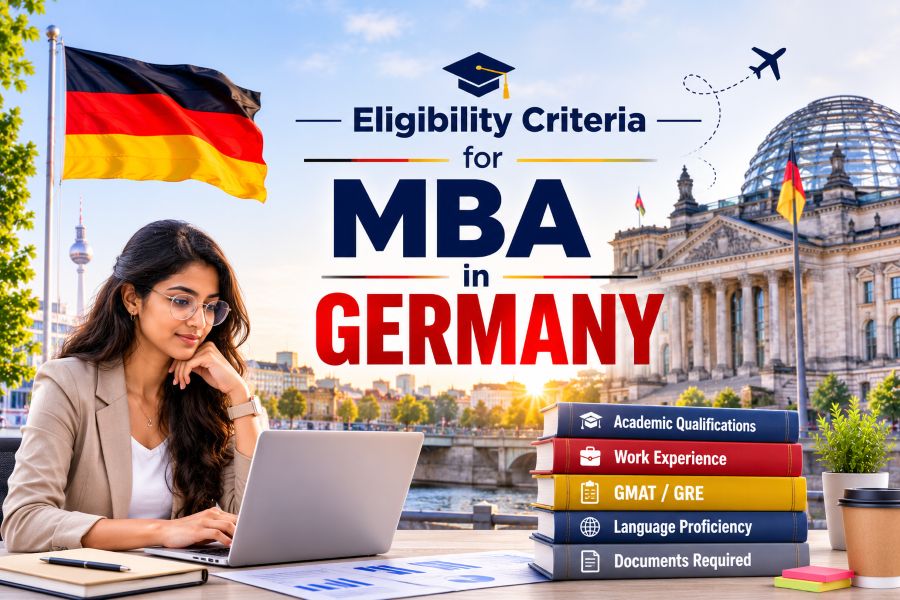
Admission to an Executive MBA is more holistic than traditional MBA admissions. Universities evaluate your professional achievements, leadership experience, academic background, and future career goals rather than focusing solely on academic scores.
Admission Requirements
Before applying, ensure you meet the university's academic, professional, and language requirements.
The table below summarises the general eligibility criteria.
Requirement | Typical Criteria |
Bachelor's Degree | Recognised 3 or 4-year degree |
Work Experience | Minimum 3–5 years (top schools often prefer 8–10 years) |
Leadership Experience | Preferred for most Executive MBA programmes |
IELTS | Usually 6.5–7.0 |
TOEFL iBT | Usually 90+ |
GMAT/GRE | Optional or waived by many universities |
Resume/CV | Mandatory |
Statement of Purpose (SOP) | Required |
Letters of Recommendation | Usually 1–2 |
Interview | Required by many institutions |
Tip: Many universities waive GMAT requirements for experienced professionals with strong leadership credentials.
Application Process
Preparing early improves your chances of securing admission and scholarship opportunities. Follow the application process outlined below.
Step | Action |
1 | Shortlist universities |
2 | Verify eligibility requirements |
3 | Prepare IELTS/TOEFL (if required) |
4 | Update professional CV |
5 | Write SOP |
6 | Arrange recommendation letters |
7 | Submit online application |
8 | Attend interview |
9 | Accept admission offer |
10 | Apply for visa |
Career Opportunities After an Executive MBA
Executive MBA prepares professionals for leadership positions rather than entry-level management roles. Graduates often transition into executive decision-making positions across multinational corporations, consulting firms, financial institutions, and technology companies.
Top Job Roles
The qualification significantly strengthens leadership credentials for senior management positions.
The table below highlights common career options.
Job Role | Average Annual Salary |
Chief Executive Officer (CEO) | €150,000–300,000 (Approx. ₹1.5–3 crore) |
Chief Operating Officer (COO) | €120,000–250,000 (Approx. ₹1.2–2.5 crore) |
Vice President | €100,000–180,000 (Approx. ₹1–1.8 crore) |
Director | €90,000–170,000 (Approx. ₹90 lakh–₹1.7 crore) |
Management Consultant | €90,000–180,000 (Approx. ₹90 lakh–₹1.8 crore) |
Strategy Manager | €85,000–160,000 (Approx. ₹85 lakh–₹1.6 crore) |
Industries Hiring Executive MBA Graduates
Executive MBA graduates are recruited across diverse sectors.
The table below lists the major industries.
Industry | Major Employers |
Automotive | BMW, Mercedes-Benz, Volkswagen |
Consulting | Deloitte, EY, PwC, Accenture |
Technology | SAP, Siemens, Bosch |
Banking & Finance | Deutsche Bank, Allianz, Commerzbank |
Manufacturing | BASF, Bosch, Thyssenkrupp |
Healthcare | Bayer, Fresenius |
Executive MBA Salary in Germany
Salary growth is one of the biggest reasons professionals invest in an Executive MBA. Promotions into senior management roles often lead to substantial increases in compensation.
The table below illustrates typical progression.
Career Stage | Average Salary |
Before Executive MBA | €60,000–90,000 (Approx. ₹60 lakh–₹90 lakh) |
Immediately After Executive MBA | €90,000–130,000 (Approx. ₹90 lakh–₹1.3 crore) |
Senior Leadership | €120,000–180,000 (Approx. ₹1.2–1.8 crore) |
C-suite Executives | €180,000–300,000+ (Approx. ₹1.8–3 crore+) |
ROI Analysis of Executive MBA in Germany
Executive MBA requires significant financial investment, but it also provides long-term career benefits through promotions, executive networking, and leadership development.
The table below summarises the return on investment.
Factor | Outcome |
Investment | €40,000–260,000 (Approx. ₹40 lakh–₹2.6 crore) |
Salary Growth | Often 30–70% after graduation |
Leadership Skills | Significant improvement |
Global Network | Access to senior executives worldwide |
Career Advancement | Higher likelihood of promotions into leadership roles |
Author's Final Thought
Executive MBA in Germany is excellent for experienced professionals who want to strengthen leadership capabilities without interrupting their careers. Flexible programme structures, internationally recognised business schools and strong corporate connections make Germany one of Europe's leading destinations for executive education.
Whether your objective is career advancement, international exposure, higher executive compensation, or transitioning into C-suite leadership, Germany provides outstanding opportunities through globally respected Executive MBA programmes.
Have more questions? Connect on 1:1 free session with our experienced study abroad experts