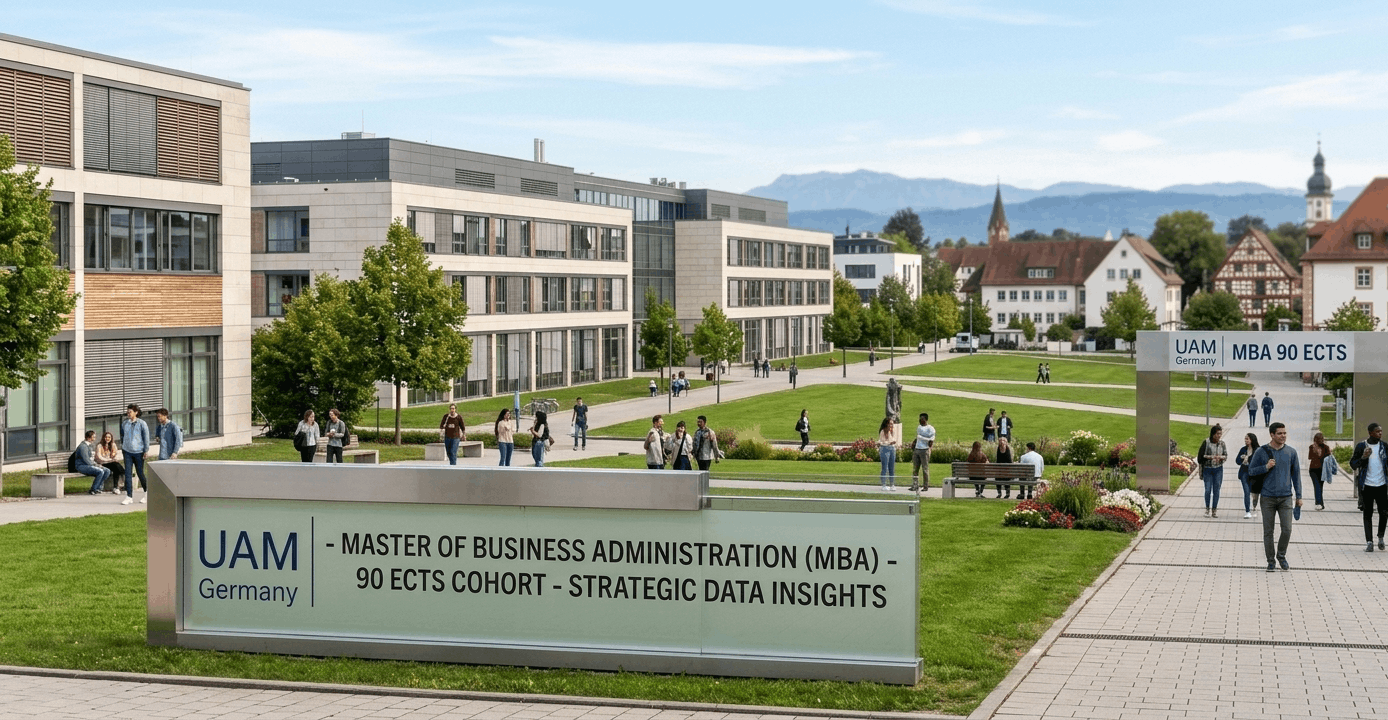
MBA 90 ECTS at UAM Germany
Table of Contents
- Why Study MBA 90 ECTS at UAM Germany
- Course Structure of MBA 90 ECTS at UAM Germany
- Eligibility and Admission Requirements for MBA 90 ECTS at UAM Germany
- How to Apply for MBA 90 ECTS at UAM Germany
- Cost of Studying MBA 90 ECTS at UAM Germany
- Scholarships for MBA 90 ECTS at UAM Germany
- Student Visa Requirements for MBA 90 ECTS at UAM Germany
- Career Opportunities After MBA 90 ECTS at UAM Germany
- Author's POV
The MBA 90 ECTS at UAM Germany is an 18-month, semi-virtual programme run by the University of Applied Management (Hochschule für angewandtes Management), combining online coursework with in-person seminars across 14 German campuses. Tuition runs at EUR 595 per month (INR 63,300), totalling roughly EUR 10,710 (INR 11.4 lakh) for the full 90-credit programme, well below most traditional European MBAs. UAM reports a 99 percent graduate employability rate, and students can specialise in Innovation Management or Intercultural Management in their final semester. The format is built specifically for working professionals who want a German-accredited MBA without pausing their careers.
Key Highlights: MBA 90 ECTS at UAM Germany
Key Highlights | Course Details |
Programme Duration | 18 months (3 semesters), part-time and flexible |
Degree Awarded | Master of Business Administration (MBA) in General Management, 90 ECTS |
Course Type | Semi-virtual, blended learning with in-person seminars |
Tuition Rate | EUR 595/month (INR 63,300/month) |
Campuses | Berlin, Dortmund/Unna, Munich/Ismaning, and others across Germany |
Core Focus Areas | Innovation Management or Intercultural Management specialisation |
Post-Study Work Option | 18-month post-study work visa for non-EU graduates |
Career Outcomes | Project Manager, Marketing Manager, Management Consultant, Analytics Manager |
Why Study MBA 90 ECTS at UAM Germany
UAM isn't the kind of university that shows up in the QS World University Rankings 2027, and it's worth being upfront about that rather than dressing it up. As a small, private Fachhochschule focused on applied management, it sits outside the scope of QS's largely research-university-focused ranking system entirely.
What UAM does have is a genuinely distinctive delivery model and a set of official recognitions worth knowing about. It's one of only five universities in Bavaria to hold unconditional system accreditation from the German Accreditation Council, and its degrees are recognised under FIBAA's Bologna Process framework.
A few reasons students still choose this route over a traditional full-time MBA:
A semi-virtual format that lets you keep working while studying, with in-person seminars concentrated into blocks rather than daily attendance
Fourteen campus locations across Germany plus one in Austria, so you can often study near where you already live or work
A curriculum built around real business challenges, industry partnerships, and applied projects rather than purely academic theory
The option to specialise in either Innovation Management or Intercultural Management in your final semester
A network of over 4,000 students taught by around 60 professors, many with direct industry backgrounds
UAM's own reported employability rate of nearly 99 percent for graduates finding permanent roles
Course Structure of MBA 90 ECTS at UAM Germany
The MBA 90 ECTS at UAM runs across three semesters, roughly 18 months, combining a "Kompetenzstudium" approach, heavy on applied practice, with virtual teaching sessions punctuated by in-person seminar phases.
For international students accessing the programme through an accelerator or partner pathway, the structure typically splits into an initial online phase covering foundational business principles, followed by an on-campus phase in Germany covering core management strategy and your chosen specialisation.
Course Structure:
Programme Stage | What It Covers |
Foundational Phase | Business fundamentals, management methods and skills, global markets |
Core Management Phase | Corporate strategy, intercultural human resource management, global leadership and change |
Specialisation | Choice of Innovation Management or Intercultural Management |
Practical Component | Real-world projects, industry collaborations, applied research |
How the Semi-Virtual Format Actually Works
Classes combine virtual teaching with concentrated in-person seminar weekends at your chosen campus, whether that's Berlin, Munich/Ismaning, or Dortmund/Unna, rather than requiring daily physical attendance throughout.
This structure is specifically designed so students can continue working professionally alongside their studies, which is also reflected in UAM's own admission requirement of at least one year of relevant work experience.
Eligibility and Admission Requirements for MBA 90 ECTS at UAM Germany
Admission to the UAM MBA 90 ECTS requires a completed bachelor's degree, at least one year of relevant professional experience, and, for non-German speakers, proof of English proficiency where the programme is delivered in English.
Requirements differ slightly depending on whether you apply directly through UAM or through an international accelerator pathway that includes a preparatory online phase before transferring to Germany.
Academic and Work Experience Requirements
UAM's own listed requirement is a professionally qualifying higher education degree ("Berufsqualifizierender Hochschulabschluss") plus a minimum of one year of relevant work experience gained after graduation.
A recognised bachelor's degree, generally with at least 210 ECTS credits, or the opportunity to complete a pre-course programme to make up the difference
Minimum one year of relevant professional experience after your first degree
For applicants coming through partner accelerator routes, requirements can extend to a minimum aggregate of 50 percent marks in your bachelor's degree
English Language Requirements
For international applicants coming through English-taught pathways, standard test requirements apply, generally sitting around the mid-range for most European business master's programmes.
IELTS Academic 6.5 overall, with no individual section below 6.0
TOEFL iBT 87 or higher, as an accepted alternative
Duolingo English Test scores of 110 or above are also accepted through some partner pathways
How to Apply for MBA 90 ECTS at UAM Germany
Applying to UAM's MBA 90 ECTS runs through the university's own admissions process, and because the programme accepts applicants without a GMAT or GRE score, the actual paperwork leans more on your academic transcript and work history than on standardised test prep.
Step 1: Check Your ECTS Credit Total
Before applying, confirm your bachelor's degree meets the credit threshold:
UAM generally expects a bachelor's degree with at least 210 ECTS credits
If your degree falls short, a pre-course programme is available to bridge the gap before you formally start the MBA
It's worth having your transcript evaluated early so you know exactly where you stand
Step 2: Submit Academic Documents and Work Experience Proof
UAM's core admission requirement centres on a professionally qualifying degree plus relevant experience:
Degree certificate and transcripts from your bachelor's programme
Proof of at least one year of relevant work experience gained after graduation
CV detailing your academic and professional background
Step 3: Choose Your Campus
UAM runs the MBA across fourteen locations in Germany plus one in Austria, so this decision genuinely shapes your experience:
Berlin, Munich/Ismaning, and Dortmund/Unna are among the most common choices for international applicants
Living costs vary meaningfully between campuses, so it's worth weighing this alongside your work and travel plans
The in-person seminar phases are tied to whichever campus you select
Step 4: Submit English Language Test Scores, If Required
For applicants coming through English-taught pathways, proficiency proof is required:
IELTS Academic 6.5 overall, with no section below 6.0
TOEFL iBT 87 or higher
Duolingo English Test scores of 110 or above, accepted through some partner routes
Step 5: Complete Enrolment and Pay Your Deposit
Once accepted, formal enrolment involves confirming your place and setting up your monthly payment plan:
UAM bills tuition monthly under its "Studium Plus" model at EUR 595 per month (INR 63,300 per month).
Applicants enrolling before the specified deadline may qualify for the Fast-Mover discount, worth roughly EUR 500 (INR 53,200) off total tuition
Confirm your semester start date, since the programme runs on a three-semester structure
Step 6: Apply for Your German Student Visa
Once your admission is confirmed, non-EU applicants move on to visa formalities:
Apply for the German National (D) Visa for study purposes at your nearest consulate
Arrange proof of financial resources, typically through a blocked account
Secure mandatory German health insurance before your visa appointment, since it's a hard requirement
Cost of Studying MBA 90 ECTS at UAM Germany
The total cost of the MBA 90 ECTS comes down to tuition, paid monthly under UAM's official "Studium Plus" model, plus living expenses, which vary considerably depending on which of UAM's German campuses you choose.
Official tuition for the standard domestic and EU pathway sits at EUR 595 per month (INR 63,300), running across the full 18-month, three-semester programme.
Tuition Fees for MBA 90 ECTS at UAM Germany:
Fee Component | Amount (EUR) | Amount (INR, approx.) |
Monthly tuition, Studium Plus model | €595/month | ₹63,300/month |
Total programme cost (18 months, approx.) | €10,710 | ₹11.4 lakh |
International accelerator on-campus phase (12 months) | €11,535 | ₹12.3 lakh |
Note: International students accessing UAM through a partner accelerator pathway may see a different fee structure, typically a separate charge for a preceding online phase before the on-campus German tuition applies. It's worth confirming the exact route and total cost directly with UAM's international office before enrolling.
Cost of Living in Germany for UAM MBA Students
Living costs vary sharply by campus city, with Munich sitting at the expensive end of UAM's location list and Numbeo confirming it as the most expensive city in the country.
Estimated Monthly Living Cost by Campus City:
Campus City | Monthly Cost, Excluding Rent (EUR) | INR Equivalent |
Munich (Numbeo, single person) | €1,108.6 | ₹1.18 lakh |
Germany national average (Numbeo, single person) | €1,004.0 | ₹1.07 lakh |
Berlin (general estimate, including rent) | €2,180 | ₹2.32 lakh |
Hence, Approximate Annual Living Cost: EUR 11,904 (INR 12.7 lakh), based on UAM's own official estimate for the international accelerator pathway, and total programme cost including tuition typically lands between EUR 22,600–23,400 (INR 24.0L–24.9L).
Must check: Cost of MBA in Germany
Scholarships for MBA 90 ECTS at UAM Germany
UAM combines its own merit-based tuition discounts with access to broader German funding programmes, so it's worth checking both sources rather than assuming the university scholarship is your only option.
Most of these awards knock a set amount or percentage off your total cost rather than covering the degree in full, so treat them as meaningful discounts, not a free ride.
Scholarship | Eligibility | Coverage |
UAM International Excellence Scholarship | Exceptional academic record or significant professional achievement, selected by the university | Tuition fee waiver of up to 20 percent |
DAAD Scholarships | International students meeting the German Academic Exchange Service's specific programme criteria | Monthly stipend of approximately EUR 934 (INR 99,400) |
Deutschlandstipendium | Talented students, regardless of nationality or income, at participating institutions | EUR 300 (INR 31,900) per month |
UAM Fast-Mover (Early Bird) Discount | Applicants who complete enrolment and pay the initial deposit before the specified deadline | Approximately EUR 500 (INR 53,200) off total tuition |
Stack the Fast-Mover discount with the DAAD or Deutschlandstipendium wherever your eligibility allows, since none of these appear to be mutually exclusive, and the combination can meaningfully bring down your total 18-month cost.
Student Visa Requirements for MBA 90 ECTS at UAM Germany
Indian and other non-EU students planning to pursue the MBA 90 ECTS at UAM Germany typically apply for a German National (D) Visa for study purposes, converting to a residence permit after arrival.
What You'll Generally Need:
A confirmed admission letter from UAM
Proof of financial resources, generally demonstrated through a blocked account or formal financial declaration
Proof of German health insurance coverage, which is mandatory for all students
A completed visa application at your nearest German consulate or embassy
Part-Time Work and Post-Study Options:
International students in Germany can generally work up to 120 full days or 240 half days per year, capped at 20 hours per week during term
Graduates of recognised programmes like the UAM MBA are eligible for an 18-month post-study work visa, allowing time to search for and secure qualified employment in Germany
Typical hourly wages for part-time student work in Germany sit around EUR 10-13
Career Opportunities After MBA 90 ECTS at UAM Germany
UAM MBA graduates move into management, marketing, consulting, and analytics roles across German and European companies, with salaries varying considerably by city and industry sector. Job Opportunities in Germany after MBA is strong across consulting, finance, technology, automotive, manufacturing, supply chain, and sustainability.
Top Job Roles and Salary Ranges (UAM's Own Reported Outcomes vs. Munich Market Data):
Role | UAM-Reported Average (EUR/INR per year) | Munich Market Range (EUR/INR per year, Glassdoor) |
Project Manager | €75,000 (INR 79.8L) | €58,000–94,750 (INR 61.7L–1.01Cr) |
International Marketing Manager | €66,000 (INR 70.2L) | €46,020–88,500 (INR 49.0L–94.1L) |
Analytics Manager | €60,000 (INR 63.8L) | €80,251–115,001 (INR 85.4L–1.22Cr) |
Management Consultant | €60,633 (INR 64.5L) | €64,000–78,000 (INR 68.1L–83.0L) |
Read More: MBA salary in Germany
Author's POV
The MBA 90 ECTS at UAM Germany is best suited for working professionals who want flexibility without putting their careers on hold. Instead of following the traditional full-time MBA model, it allows students to study while continuing to work, making the monthly fee structure much easier to manage. Although UAM is not a globally ranked research university, its strength lies in practical learning, industry relevance, and accredited programmes across multiple campuses in Germany.
Salary growth after graduation is possible, but it usually comes with experience rather than immediately after earning the degree. That’s why it's better to view the MBA 90 ECTS at UAM Germany as a long-term career investment instead of expecting an instant salary jump. For professionals looking to upskill, gain a recognised German qualification, and benefit from Germany's post-study work opportunities, this programme offers solid value and flexibility.
Connect with our experts for a free 1:1 counseling session to explore course options, career pathways, and more.