MBA in Data Analytics in Germany
Table of Contents
- Top MBA in Data Analytics Colleges in Germany
- MBA in Data Analytics Syllabus in Germany
- Cost for studying MBA in Data Analytics in Germany
- Scholarships for MBA in Data Analytics in Germany
- Eligibility for MBA in Data Analytics in Germany
- Admission Requirements for MBA in Data Analytics in Germany
- Application Process for MBA in Data Analytics in Germany
- MBA in Data Analytics Jobs in Germany
- Author's Final Thoughts
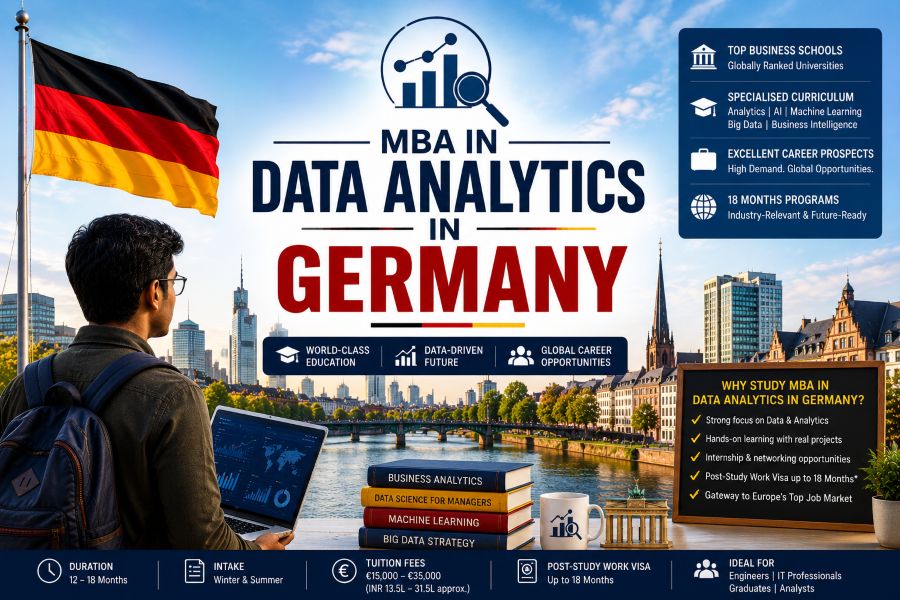
MBA in Data Analytics in Germany is smartest career investments for professionals who want to combine business leadership with analytical decision-making. Germany's rapidly growing AI ecosystem, Industry 4.0 transformation, automotive innovation, fintech expansion and manufacturing excellence have increased demand for managers who understand both business strategy and data-driven decision making.
MBA in Data Analytics Germany teaches business fundamentals alongside modern analytical tools such as Python, SQL, Tableau, Power BI, predictive analytics, machine learning and business intelligence. Most programs are completed within 18–24 months, are taught in English and offer excellent opportunities to work with global companies including SAP, BMW, Bosch, Siemens, Amazon, Zalando and Deutsche Bank. Public universities either charge no tuition or very minimal fees, while graduates receive an 18-month post-study residence permit to find employment.
Key Highlights: MBA in Data Analytics Germany
Particular | Details |
Course Duration | 18–24 Months |
Degree Type | MBA |
Teaching Language | English |
Tuition Fee (Public Universities) | €0–€2,000/year (Approx. ₹0–2 lakh) |
Tuition Fee (Private Universities) | €10,000–€22,000/year (Approx. ₹10–22 lakh) |
Living Cost | €934–€1,200/month (Approx. ₹93,000–₹1.2 lakh) |
Average Starting Salary | €55,000–€75,000 (Approx. ₹55–75 lakh) |
Experienced Salary | €80,000–€120,000+ (Approx. ₹80 lakh–₹1.2 crore+) |
Work Permit After Graduation | 18 Months |
Popular Industries | AI, Consulting, Manufacturing, Automotive, FinTech, E-commerce |
Top MBA in Data Analytics Colleges in Germany
Germany hosts several globally respected institutions offering specialized MBA programs focused on analytics, artificial intelligence, business intelligence and digital transformation. Private institutions provide highly industry-focused curricula with strong corporate partnerships.
The table below highlights recognized MBA in Data Analytics colleges in Germany :
University | Tuition Fee | Location |
Steinbeis University | €21,800 (Approx. ₹21.8 lakh) | Berlin |
Macromedia University of Applied Sciences | €10,000–€15,000/year (Approx. ₹10–15 lakh) | Munich/Berlin |
GISMA University of Applied Sciences | €10,000–€15,000/year (Approx. ₹10–15 lakh) | Berlin |
ESB Business School (Reutlingen University) | Public university fees | Reutlingen |
Technical University of Munich (Selected Analytics Programmes) | Semester Contribution | Munich |
Which MBA in Data Analytics Colleges in Germany to Choose?
Choosing the right university isn't about rankings alone, it's about selecting a programme that aligns with your career aspirations.
Steinbeis University is an excellent choice for professionals interested in AI leadership, business transformation, and consulting.
Macromedia University offers a practical curriculum ideal for students targeting digital marketing analytics, business intelligence, and product management.
GISMA University is suitable for students who want strong corporate exposure and international networking.
ESB Business School is among the strongest options for students interested in analytical decision-making, operations, and management consulting.
Technical University of Munich (TUM) appeals to candidates aiming for research-driven analytics, innovation, and technology management careers.
Advice: Don't select a university purely because it's located in Berlin or Munich. Compare curriculum, internship opportunities, alumni network, industry collaborations, tuition fees and placement support before making your decision.
MBA in Data Analytics Syllabus in Germany
MBA in Data Analytics in Germany integrates business strategy with data science, artificial intelligence and analytical decision-making. Most programs follow European Credit Transfer System (ECTS), ensuring global recognition and easy academic mobility across Europe.
The table below explains MBA in Data Analytics course in Germany is structured:
Component | Details |
Duration | 18–24 months (3–4 semesters) |
Credits | 90–120 ECTS |
Teaching Language | Primarily English |
Academic Calendar | Winter Intake (October) and selected Summer Intake (April) |
Learning Format | Lectures, Case Studies, Live Projects, Industry Consulting, Internship, Thesis |
Internship | Mandatory or strongly recommended in many programmes |
Final Assessment | Capstone Project / Master's Thesis |
Semester-wise Curriculum
Most universities progressively build analytical, managerial, and leadership capabilities throughout the programme.
Semester | Major Subjects |
Semester 1 | Business Analytics, Statistical Programming, Python, Data Management, Economics, Leadership |
Semester 2 | Machine Learning, SQL, Data Mining, AI in Business, Financial Analytics, Marketing Analytics |
Semester 3 | Predictive Analytics, Big Data, Tableau, Power BI, Consulting Projects, Industry Internship |
Semester 4 (where applicable) | Capstone Project, Master's Thesis, Corporate Research Project |
Teaching Methodology
Instead of relying solely on classroom lectures, German universities emphasise applied learning through:
Live consulting assignments
Corporate case studies
AI laboratories
Business simulations
Internship opportunities
Industry-sponsored capstone projects
Cross-functional teamwork
Leadership workshops
This practical approach is one of the biggest reasons graduates are highly employable in Data analytics jobs in Germany, particularly across consulting, automotive, manufacturing, fintech and technology sectors.
Cost for studying MBA in Data Analytics in Germany
Germany offers MBA programs for almost every budget. Where public universities remain the most affordable choice with little or no tuition fees, private universities provide specialized industry-focused curricula, smaller class sizes and stronger corporate collaborations.
Compare public and private universities offering MBA in Data Analytics Germany:
University | Type | Tuition Fee | Location |
ESB Business School (Reutlingen University) | Public | Semester contribution only (€150–€350) (Approx. ₹15,000–₹35,000) | Reutlingen |
Steinbeis University | Private | €21,800 total (Approx. ₹21.8 lakh) | Berlin |
Macromedia University | Private | €10,000–€15,000/year (Approx. ₹10–15 lakh) | Munich/Berlin |
GISMA University of Applied Sciences | Private | €10,000–€15,000/year (Approx. ₹10–15 lakh) | Berlin |
Living Expenses
Living costs vary depending on the city you choose. Munich and Frankfurt are the most expensive, while cities like Leipzig, Dresden and Magdeburg are considerably more affordable.
Below is an estimated monthly student budget.
Expense | Estimated Monthly Cost |
Accommodation | €350–€700 (Approx. ₹35,000–₹70,000) |
Food | €180–€250 (Approx. ₹18,000–₹25,000) |
Health Insurance | €120–€140 (Approx. ₹12,000–₹14,000) |
Transportation | €40–€70 (Approx. ₹4,000–₹7,000) |
Personal Expenses | €150–€200 (Approx. ₹15,000–₹20,000) |
Average Monthly Budget: €934–€1,200 (Approx. ₹93,000–₹1.2 lakh)
Scholarships for MBA in Data Analytics in Germany
MBA scholarships in Germany for Indian students are several like merit-based, need-based and government-funded that reduces overall study costs. Some universities also provide internal scholarships specifically for international postgraduate students pursuing analytics, AI and management programs.
Here are some of the best scholarship opportunities for students pursuing MBA in Data Analytics Germany:
Scholarship | Funding | Eligibility |
DAAD Scholarship | €934–€1,400/month (Approx. ₹93,000–₹1.4 lakh) | Outstanding academic record and relevant work experience |
Deutschlandstipendium | €300/month (Approx. ₹30,000) | Academic excellence and extracurricular achievements |
Erasmus+ Scholarship | Tuition + monthly stipend | Partner university exchange programmes |
Heinrich Böll Foundation | Up to €1,400/month (Approx. ₹1.4 lakh) | Sustainability and social leadership |
Konrad Adenauer Foundation | Monthly stipend + networking support | Academic excellence and leadership potential |
Friedrich Ebert Foundation | Living expenses + tuition support | High-achieving students with strong social commitment |
University-specific Scholarships | Partial tuition waiver | Merit-based |
Eligibility for MBA in Data Analytics in Germany
Admissions for MBA in Data Analytics Germany is competitive but straightforward if you satisfy the academic and professional requirements. Universities assess educational background, work experience, analytical aptitude and English proficiency before making admission decisions.
Students should meet the following eligibility criteria before applying.
Requirement | Typical Requirement |
Bachelor's Degree | Minimum 3 or 4-year degree from a recognised university |
Academic Performance | Equivalent to German GPA 2.5 or better (around 60–70% depending on university) |
Work Experience | 2–5 years preferred (varies by university) |
English Proficiency | IELTS 6.5–7.0 or TOEFL 90–100 |
APS Certificate | Mandatory for Indian applicants |
GMAT/GRE | Optional at many universities but advantageous for competitive programmes |
Professional experience in IT, engineering, finance, consulting, operations or business analytics can strengthen your application.
Admission Requirements for MBA in Data Analytics in Germany
Every university has its own admission criteria, but the overall requirements remain similar across institutions. Preparing your documentation early improves chances of securing admission and scholarship opportunities.
Academic Requirements
Applicants generally require:
Bachelor's degree in Business, Engineering, Computer Science, IT, Mathematics, Economics, Statistics, or related fields
Competitive academic performance
Updated CV highlighting professional achievements
Statement of Purpose (SOP)
Letters of Recommendation (LORs)
Language Requirements
Most English-taught programs require:
Test | Minimum Score |
IELTS | 6.5–7.0 |
TOEFL iBT | 90–100 |
PTE Academic | 58–65 |
Learning basic German (A1–A2) is highly recommended even if your programme is entirely in English, as it improves networking, internships and employment prospects.
Documents Required
Prepare the following before applications open:
Academic transcripts
Degree certificate
Passport
APS Certificate
Resume/CV
SOP
LORs
English language scores
Work experience certificates
Passport photographs
Application Process for MBA in Data Analytics in Germany
Applying for MBA in Data Analytics Germany involves multiple stages. Starting your preparation at least 10–12 months before the intake allows sufficient time for document verification, APS processing, university applications and visa approval.
Follow this step-by-step application process.
Research universities offering analytics-focused MBA programmes.
Verify eligibility and admission requirements.
Obtain your APS Certificate.
Take IELTS/TOEFL (and GMAT if applicable).
Prepare SOP, CV, and recommendation letters.
Submit online applications through university portals.
Receive admission offer.
Arrange finances and blocked account (if applicable).
Apply for German student visa.
Travel to Germany and complete university enrolment.
Student Visa Process
Indian students require a German National Student Visa. Generally requires the following :
Admission Letter
APS Certificate
Valid Passport
Proof of Financial Resources
Health Insurance
Visa Application Form
Passport-sized photographs
Academic documents
Proof of accommodation (if available)
MBA in Data Analytics Jobs in Germany
MBA in Data Analytics Germany offers excellent employment market. Germany's digital transformation, AI adoption, manufacturing innovation and financial technology sectors create strong demand for analytics professionals capable of combining business strategy with data-driven decision-making.
Below are some MBA in data analytics salary ranges across popular roles.
Job Role | Average Annual Salary |
Business Analyst | €55,000–€75,000 (Approx. ₹55–75 lakh) |
Data Analyst | €50,000–€70,000 (Approx. ₹50–70 lakh) |
Product Manager | €70,000–€100,000 (Approx. ₹70 lakh–₹1 crore) |
Business Intelligence Consultant | €65,000–€95,000 (Approx. ₹65–95 lakh) |
Data Scientist | €70,000–€105,000 (Approx. ₹70 lakh–₹1.05 crore) |
Analytics Manager | €90,000–€130,000 (Approx. ₹90 lakh–₹1.3 crore) |
AI Strategy Consultant | €95,000–€140,000 (Approx. ₹95 lakh–₹1.4 crore) |
Graduates can explore diverse Data analytics jobs in Germany, with opportunities available across consulting firms, multinational corporations, technology companies, automotive manufacturers, healthcare, banking and logistics organizations.
Top Recruiters
Germany hosts Europe's largest employers actively recruiting MBA graduates specializing in analytics.
These organizations frequently hire graduates for Data analytics jobs in Germany:
Company | Industry |
SAP | Enterprise Software |
BMW Group | Automotive |
Bosch | Manufacturing & Engineering |
Siemens | Industrial Technology |
Deutsche Bank | Banking |
Allianz | Insurance |
Amazon Germany | E-commerce |
Zalando | Retail Technology |
Deloitte Germany | Consulting |
Accenture Germany | Consulting & Technology |
PwC Germany | Advisory |
BASF | Chemicals |
Advice: While English is sufficient for many multinational employers, attaining B1–B2 German proficiency improves access to management positions, client-facing roles and long-term career growth.
Author's Final Thoughts
MBA in Data Analytics in Germany is a superb option for Indian professionals seeking career in analytical and AI-driven decision-making. Germany's globally respected universities, affordable education, practical learning and strong industry opportunities, make it one of Europe's most robust employment markets.
If your goal is to build a career in consulting, technology, product management, finance or business intelligence, Germany provides exceptional opportunities with attractive salaries and long-term career prospects.
Selecting the right university, preparing a strong application and developing analytical as well as German language skills will only improve your ROI. For further guidance, connect on a 1:1 session with our study abroad experts.
Frequently Asked Questions
It depends on your career goals. An MBA in Data Analytics Germany is ideal for professionals aiming for leadership, consulting, or managerial roles, while an MS focuses more on technical analytics, programming, and research-oriented careers.
Yes. Many universities accept applicants from commerce, economics, finance, mathematics, management, and even humanities backgrounds, provided they have relevant work experience or demonstrate analytical aptitude during the admission process.
No. Most programmes teach Python, SQL, Tableau, and Power BI from foundational to intermediate levels. However, having basic familiarity with spreadsheets, statistics, or programming can make your coursework much easier.
Not always. Several German universities have waived GMAT requirements or consider it optional. However, a strong GMAT score can strengthen your application, especially if your academic profile or work experience is relatively average.
Absolutely. One of the biggest advantages of an MBA in Data Analytics Germany is that it enables professionals from diverse industries to transition into analytics, business intelligence, consulting, product management, and AI-driven business roles.
Berlin, Munich, Frankfurt, Hamburg, Stuttgart, and Cologne remain the leading destinations because of their concentration of technology firms, consulting companies, automotive manufacturers, financial institutions, and multinational corporations.
While many multinational companies recruit English-speaking professionals, learning German to at least B1 or B2 level significantly improves your chances of securing managerial roles, client-facing positions, and higher-paying opportunities across German companies.
Yes. Graduates are generally eligible for an 18-month post-study residence permit, allowing sufficient time to search for employment. Once employed, many professionals transition to an EU Blue Card or other long-term residence pathways.
Learning the basics of Excel, SQL, Python, Power BI, Tableau, and statistics before beginning your programme can give you a significant academic advantage and make internship applications much stronger.
Not every university makes internships compulsory, but many programmes either integrate internships into the curriculum or strongly encourage students to gain practical corporate experience through live consulting projects and industry collaborations.
Yes. Degrees from accredited German universities are recognized worldwide. Graduates work across Europe, North America, the Middle East, Singapore, and Australia in consulting, technology, banking, healthcare analytics, manufacturing, and product management roles.