
MBA in Business Analytics in Germany
Table of Contents
- Top Universities for MBA in Business Analytics in Germany
- MBA in Business Analytics Syllabus in Germany
- Course Module of MBA in Business Analytics in Germany
- Cost of MBA in Business Analytics in Germany
- Cost of Living in Germany
- Eligibility Requirements for MBA in Business Analytics
- Intakes & Admission Timeline for MBA in Business Analytics in Germany
- How to Apply for MBA in Business Analytics in Germany
- Online MBA in Business Analytics Germany
- Scholarships for MBA in Business Analytics
- MBA in business analytics salary in Germany
- Author’s Final Thought
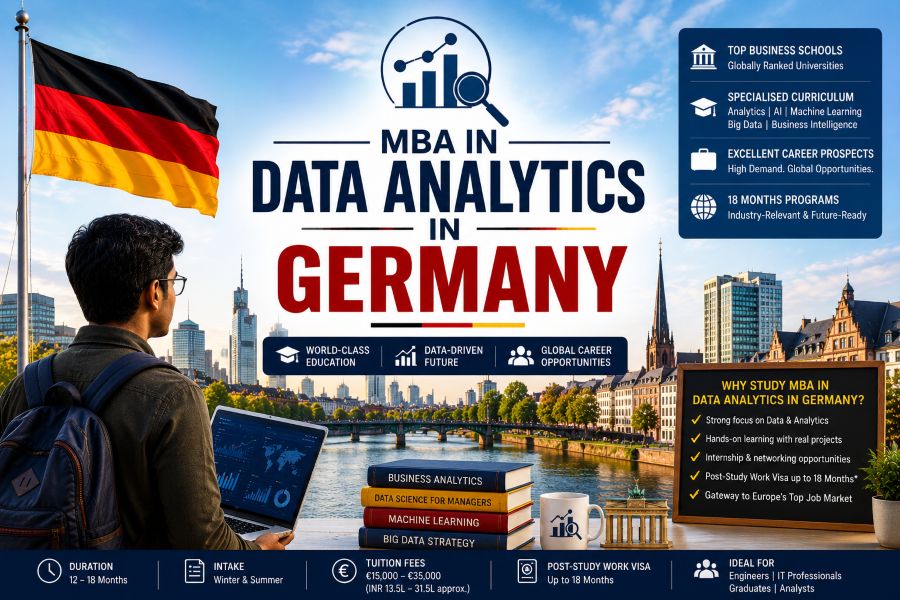
MBA in Business Analytics in Germany focuses heavily on data analytics, machine learning applications, business intelligence tools, ERP systems, cloud computing, predictive analytics, and digital transformation. Most programs are completed within 12–18 months, with tuition ranging from tuition-free public universities (semester contribution only) to approx. €5,000–€45,000 (Approx. ₹5.4L–45 lakh) at private business schools. Germany's strong industrial ecosystem also provides exceptional internship opportunities and direct access to multinational employers with 18-month post-study work visas.
Key Highlights : MBA in Business Analytics in German
Particular | Details |
Course Duration | 12–18 Months |
Tuition Fees (Public) | Semester Contribution €200–€400 (Approx. ₹20,000–₹40,000) |
Tuition Fees (Private) | €15,000–€45,000 (Approx. ₹15–45 lakh) |
Living Expenses | Monthly €992–€1,200 (Approx. ₹99,000–₹1.2 lakh) |
Work Experience | 2–3 Years |
APS Certificate | Mandatory for Indian Students |
Post Study Residence Permit | Up to 18 Months |
Graduate Salary | €55,000–€95,000/year (Approx. ₹55–95 lakh/year) |
This blog covers all information students need to make a confident decision about their path in MBA in Business Analytics in Germany.
Top Universities for MBA in Business Analytics in Germany
Germany offers several excellent universities and private business schools, like IU offers one of Germany's most flexible MBA programs with a Business Analytics specialisation. HWR Berlin enjoys an outstanding reputation for management education and practical business training.
The table below compares some of the leading institutions.
University | Duration | Tuition Fees |
IU International University of Applied Sciences | 18 Months | €5,330–€9,000/semester (Approx. ₹5.3–9 lakh/semester) |
HWR Berlin | 15–18 Months | Semester Contribution / Program-specific |
EU Business School Munich | 12 Months | €20,000–€30,000 (Approx. ₹20–30 lakh) |
GISMA Business School | 12–24 Months | €16,000–€25,000 (Approx. ₹16–25 lakh) |
SRH Berlin University | 18 Months | €15,000–€22,000 (Approx. ₹15–22 lakh) |
MBA in Business Analytics Syllabus in Germany
The MBA in Business Analytics syllabus includes management fundamentals, advanced analytical techniques, helping graduates develop business leadership and technical decision-making skills.
The table below outlines the core syllabus covered across most universities.
Semester | Course Module | Skills Developed |
Semester 1 | Financial Management, Marketing, Organisational Behaviour, Business Statistics | Management Foundations |
Semester 2 | Business Intelligence, Data Analytics, Machine Learning, Predictive Analytics, Strategic Management | Analytics & Decision Making |
Final Phase | Capstone Project, Consulting Assignment, Industry Project | Practical Business Application |
Students graduate with practical knowledge of SQL, Tableau, Power BI, Python, R, ERP systems, cloud analytics platforms and enterprise decision-making frameworks.
Course Module of MBA in Business Analytics in Germany
Universities emphasise practical applications through real-world business projects and consulting assignments. Practical modules help with employability as students gain experience working on real datasets and business challenges before entering the workforce.
The table below highlights the practical modules frequently included in Business Analytics MBA programs.
Module | Learning Outcome | Industry Relevance |
Business Intelligence | Dashboard Development & Reporting | Corporate Decision Making |
Data Visualisation | Tableau, Power BI | Executive Reporting |
Machine Learning Applications | Predictive Models | AI & Automation |
Enterprise Analytics | ERP & Business Systems | Manufacturing & Operations |
Consulting Project | Real Client Problem Solving | Industry Experience |
Cost of MBA in Business Analytics in Germany
German MBA costs are flexible as tuition structures depend on whether students choose public universities or private business schools. Cost of studying in Germany for public schools is mostly tuition-free and charge per semester, private school cost charge a substantial tuition fee.
The table below compares tuition costs across different institution categories.
University Tier | Tuition Fees | Examples |
Public Universities | €200–€400/semester (Approx. ₹20,000–₹40,000) | HWR Berlin |
Mid-tier Private Schools | €15,000–€25,000 (Approx. ₹15–25 lakh) | SRH Berlin, GISMA |
Premium Private Business Schools | €25,000–€45,000 (Approx. ₹25–45 lakh) | EU Business School, IU |
Cost of Living in Germany
Apart from tuition fees, students should budget for accommodation, food, transportation, health insurance, and other personal expenses. Germany also requires international students to demonstrate sufficient financial resources through a blocked account while applying for a student visa.
The table below provides estimated living expenses in popular student cities.
City | Approx. Monthly Cost |
Munich | €1,150–€1,400 (Approx. ₹1.15–1.4 lakh) |
Berlin | €950–€1,200 (Approx. ₹95,000–₹1.2 lakh) |
Frankfurt | €1,000–€1,300 (Approx. ₹1–1.3 lakh) |
Cologne | €900–€1,150 (Approx. ₹90,000–₹1.15 lakh) |
Hamburg | €950–€1,200 (Approx. ₹95,000–₹1.2 lakh) |
For visa purposes, students are required to maintain a blocked account of €11,904 annually (Approx. ₹11.9 lakh) to demonstrate adequate financial support.
Eligibility Requirements for MBA in Business Analytics
Unlike MSc Business Analytics programs, MBA programs expect applicants to have prior professional experience alongside academic qualifications.
The table below summarises the common admission requirements.
Requirement | Public Universities | Private Business Schools |
Bachelor's Degree | Relevant 3–4 year degree | Required |
Academic Score | Usually 70–75% equivalent | 60–70%+ |
Work Experience | Usually 2–3 years | 2–5 years |
IELTS/TOEFL | IELTS 6.5+ | IELTS 6.5+ |
APS Certificate | Mandatory | Mandatory |
GMAT/GRE | Program-specific | Preferred by many institutions |
Candidates from engineering, business, economics, computer science, mathematics, statistics, and IT backgrounds generally have stronger eligibility for these programs.
Work Experience Requirements
Professional experience is one of the key differences between an MBA and an MSc in Business Analytics. While some private universities may consider exceptional fresh graduates, most reputable MBA programs prefer candidates with prior industry exposure.
The table below provides a general overview.
University Type | Preferred Experience | Notes |
Public Universities | 2–3 Years | Strong academic profile required |
Private Business Schools | 2–5 Years | Leadership experience preferred |
Executive MBA Programs | 5+ Years | Designed for senior professionals |
Applicants with experience in IT, consulting, finance, operations, analytics, or project management often have a competitive advantage during admissions.
Intakes & Admission Timeline for MBA in Business Analytics in Germany
German universities generally offer two admission cycles every year. Since MBA programs have limited seats, early applications improve admission and scholarship opportunities.
Intake | Application Period | Classes Begin |
Winter Intake | May–July | October |
Summer Intake | November–January | April |
Students should ideally begin preparing their applications 8–10 months before their preferred intake to complete APS verification, language tests, and document preparation comfortably.
How to Apply for MBA in Business Analytics in Germany
Following a structured application process reduces delays and improves your chances of admission.
Step | Action | Outcome |
1 | Research universities and shortlist programs | Finalise options |
2 | Prepare IELTS/TOEFL and APS Certificate | Meet eligibility |
3 | Submit online applications | Admission evaluation |
4 | Receive admission offer | Confirm enrolment |
5 | Arrange blocked account & health insurance | Visa preparation |
6 | Apply for German student visa | Travel approval |
7 | Complete university registration | Begin studies |
Online MBA in Business Analytics Germany
Online MBA programs are becoming increasingly popular among working professionals who wish to upgrade their qualifications without leaving their current employment.
Some universities offering flexible learning options include:
University | Study Mode | Suitable For |
IU International University | Online & On-campus | Working Professionals |
GISMA Business School | Hybrid | International Students |
Arden University Germany | Online | Experienced Professionals |
Online MBA in Business Analytics is ideal for professionals seeking career advancement while maintaining employment. However, students aiming to build careers in Germany should generally prioritise on-campus programs because they offer internships, networking opportunities, and easier access to the German job market.
Scholarships for MBA in Business Analytics
MBA Scholarships in Germany are available for international students to reduce tuition costs and can also help reduce travel, accommodation expenses as well. The table below highlights available scholarships for students:
Scholarship | Financial Support | Offered By |
DAAD Scholarships | Monthly stipend & benefits | DAAD |
Deutschlandstipendium | €300/month (Approx. ₹30,000/month) | German Government |
University Merit Scholarships | Partial Tuition Waiver | Individual Universities |
Corporate Scholarships | Program-specific | Partner Companies |
Students should check scholarship deadlines separately, as they often close before university admission deadlines.
MBA in business analytics salary in Germany
MBA in business analytics graduates earn a handsome salary in Germany, as strong digital economy creates outstanding opportunities for MBA graduates specialising in analytics, artificial intelligence, consulting and enterprise intelligence.
The table below highlights approx. MBA in Business Analytics Salary :
Job Role | Average Salary | Major Recruiters |
Business Analyst | €55,000–€75,000/year (Approx. ₹55–75 lakh/year) | SAP, Deloitte, Accenture |
Data Analytics Manager | €70,000–€95,000/year (Approx. ₹70–95 lakh/year) | Siemens, Bosch, BMW |
Enterprise Intelligence Manager | €75,000–€100,000/year (Approx. ₹75 lakh–₹1 crore/year) | Amazon, Capgemini, EY |
Analytics Consultant | €65,000–€90,000/year (Approx. ₹65–90 lakh/year) | PwC, McKinsey Digital, BCG |
Germany's automotive, manufacturing, banking, logistics, and consulting sectors continue to invest heavily in business analytics, creating strong demand for qualified graduates.
Graduates securing skilled employment can eventually transition to permanent residency through Germany's immigration framework.
Author’s Final Thought
MBA in Business Analytics in Germany is a top choice for students seeking internationally recognised degrees, competitive salaries, an 18-month post-study residence permit and growing demand for analytics professionals, it prepares professionals for careers in consulting, digital transformation, enterprise intelligence and strategic decision-making. Whether you choose an affordable public university or a globally recognised private business school, Germany is the best destinations for Indian students pursuing specialised MBA.
Need personalised guidance? Connect on a 1:1 session with our experienced study abroad experts.